


Home › Featured Stories › Excursions › First Person ›
First Person: Exploring the Sheldon’s “Artists in the House” and the Relationship Between Museum and Community
 First Person by Skiles Roberts-Salvador
Approaching the Henry Sheldon Museum, located in the heart of Middlebury, I was immediately greeted by color and joy. The pillars of the Sheldon, the oldest community-based museum in America, as its website states, are currently decorated with vibrant fiber art, an act I recognized as “yarn bombing.”
Sheldon Executive Director Coco Moseley explained that the knitted pillars are an effort by trustee Kelly Hickey, who organized knitters from Addison County to contribute to the piece.
“I hope what it does is help remind our community that the museum is a place of playfulness, of curiosity, of creativity,” said Moseley. “It’s an invitation for us all to participate in it. Pretty much all of the exhibits this year have been curated by a combination of museum staff, trustees, and community members. We wanted to really engage in this idea that the community curates this space.”
 The exterior of the Henry Sheldon Museum, its pillars adorned with yarn art.
This conversation between museum and community, between history and modernity, continued upon entering the historic building. I found myself in a kitchen, as the Sheldon Museum was originally built in 1829 as a home for marble merchants Eben Judd and Lebbeus Harris. The building was later purchased in the late 19th century by Henry Sheldon, the museum’s founder. In the present day, the Sheldon offers rotating art and historical exhibits in addition to containing The Stewart-Swift Research Center, which possesses an archival collection that chronicles Vermont’s past.
The kitchen is outfitted with fixtures appropriate for the historic space–a fireplace, a woven basket, pot and pans–while the walls and surfaces contrasted with a diverse array of contemporary art as a part of its current exhibit “Artists in the House.” There are over 30 artists showcased, and all of them are local. An associated auction fundraiser splits the proceeds equally between the museum and contributing artists.
In the gallery space, I spoke with Moseley, who told me about the origin and vision for “Artists in the House,” which is located in the Sheldon’s historic kitchen.
 Inside the Sheldon’s historic kitchen room, the contemporary blends with the historic.
“In the last few years, we’ve been experimenting with bringing in different art and exhibits into this space to infuse it with a little bit of both the contemporary culture of Addison County and the rich object and museum collection that is a part of the Henry Sheldon Museum,” Moseley said. “So in some ways it’s a microcosm of the museum.”
Moseley later shared her perspective on the museum’s pairing of the past and present, stating, “Contemporary art doesn’t stand alone without its relationship to history and to the community and vice versa. It’s less about this is the new and this is the old, and more that these are in conversation with each other.”
As we looked around, she pointed out the diversity of both the artwork that decorated the room’s yellow walls and the artists who contributed to the exhibit.
“We have some folks who are professional artists selling in galleries, to some students that participated in the show, to a printmaker, a potter, a book artist. So to me it speaks to the vibrancy of art in Addison County,” she said.
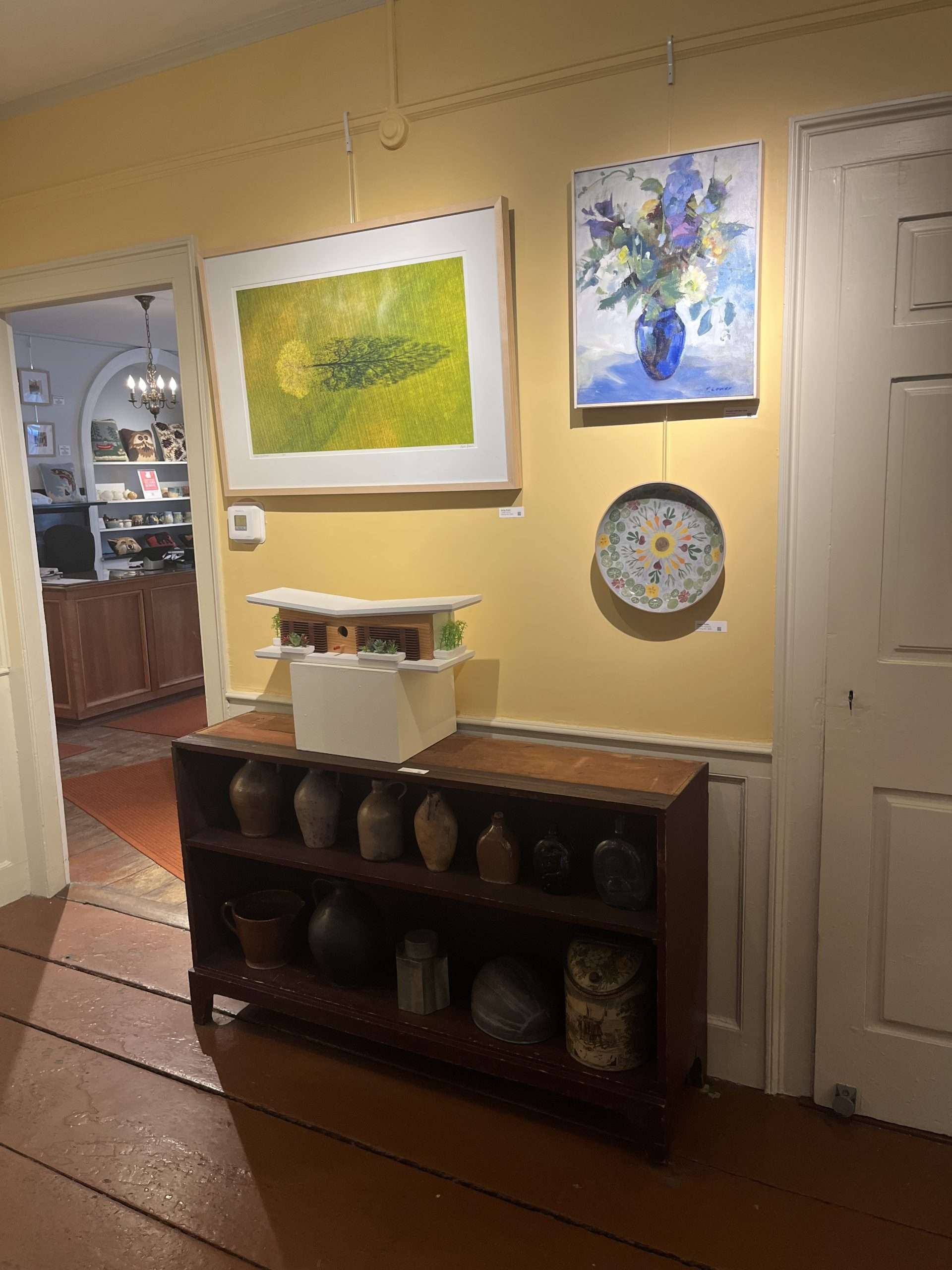 Four examples of the art that makes up the “Artists in the House” exhibit. Bottom left: “Birdhouse” by Steve Hadeka. Top left: “Spring Maple” by Caleb Kenna. Top right: “Bouquet with Blue Vase” by Fred Lower. Bottom right: “Veggie Platter” by Jennifer Roberts.
Notably, the works of art are not organized by medium or subject matter but are instead collaged together, their contrasting details creating a quilt of what art in Addison County looks like. While displayed among antique pottery that alludes to the Sheldon’s past, a mid-century modern birdhouse is also juxtaposed with an accompanying painted ceramic bowl, a print of nature photography, and an expressive painting of a flower bouquet.
Moseley credited the talents of Hickey and Middlebury College Professor of Studio Art Michelle Leftheris for their curation skills and ability to subtly put the pieces in conversation with each other.
I was particularly drawn to two, very different works of art. “There is Still Light” by Elisa Järnefelt, a pen and ink illustration, caught my eye with its bold yet whimsical graphic style. On a separate wall, “Old Nash Farm” by Michaela Granstrom, a masterful oil painting of a red barn, intrigued me. And while these pieces differ greatly, they both, at their core, represent Vermont. Granstrom’s painting portrays Old Nash Farm in New Haven, while Järnefelt’s blurb on the auction website states that the piece, “seamlessly blends the serene beauty of Vermont’s wilderness with intricate visual storytelling.” These two pieces come together with the rest of the artwork in the exhibit to tell what Moseley refers to as the “curious and complex story of Middlebury.”
“Artists in the House” alters the relationship between museum and attendee, allowing the community to act as viewer, curator, collector, and artist. It is clear that the exhibit and auction have engaged the Addison County community, with Moseley telling me that while they set a goal of 20 artists, they garnered over 30 and “probably could have kept going.”
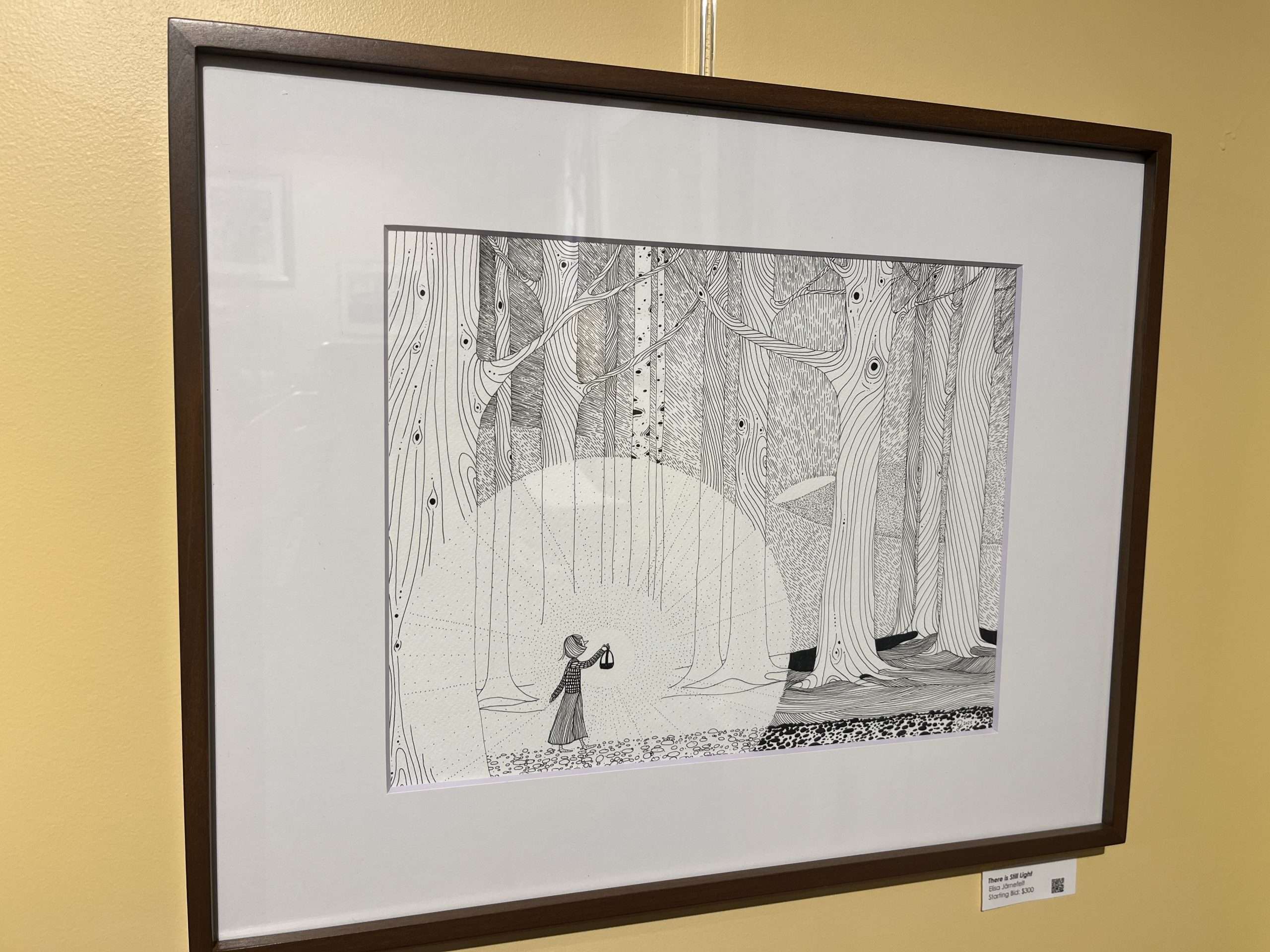 “There is Still Light” by Elisa Järnefelt.
Moseley also recalled that the gallery opening and reception on May 21 was attended by over 200 people.
“It was nice to just see such a broad cast of Addison County characters, from students to artists to community members to museum members to somebody who hasn’t been here in over 30 years,” she said.
As a “50/50 fundraiser,” the event helps the museum thrive while also benefiting local artists. Artists were able to set a minimum bid for their art, allowing for a diverse grouping of price ranges. Minimum bids ranged from $40 to $2,000.
“Artists in the House” is on display until Sept. 6 and bidding continues to take place online. The works can be viewed at the Sheldon Wednesday through Saturday from 10 a.m. to 4 p.m.
Beyond the exhibit, the Sheldon continues to engage with its wider community and Middlebury’s historic past. On June 21, I attended a reception and a pop-up exhibit there honoring early 19th-century same-sex couple Charity Bryant and Sylvia Drake. The event followed a Vermont Roadside Historic Marker dedication ceremony at Weybridge Cemetery where the couple is buried. A collaboration with the State of Vermont Division for Historic Preservation, Vermont Humanities, and the Town of Weybridge, the event unveiled the new marker and honored Addison County’s LGBTQ+ community members, both past and present.