


The Arts Operating Grant In Action: Making Magic Through Puppetry with Sandglass Theater
 Ensemble members Shoshana Bass and Dey Hernandez performing “Feral.” Photo: Shannon Herrick Photography.
What if you could see a show in an internationally acclaimed theater, close enough to the stage to make eye contact with the actors and with an audience of just over 50 people—all in a small town in southern Vermont?
Add that to a genuine feeling of magic, and you’ll have an idea of what makes Sandglass Theater in Putney such a unique place.
Rolling up to the theater feels immediately like you’re a special guest at someone’s home. Up a driveway next door to Next Stage Arts, the home of one of Vermont’s very own puppet theaters is tucked into a renovated barn in a little woodsy area. Out front, there’s a comfortable porch with cozy chairs, plaid bunting, and an interesting cage full of paper cranes.
Around the back in the walk-in basement puppet workshop, I met Shoshana Bass, Sandglass’ Executive Artistic Director. She’s also the daughter of the theater’s founders, Eric Bass and Ines Zeller Bass, who live just upstairs. I found her standing engrossed over an unfinished cow’s head sitting on the table.
“I was just nerding out with Alex here,” she told me, gesturing to Alex Vernon of Baltimore, Maryland’s Happenstance Theater, one of the performers in the show that evening. “I’m learning how to make blinking eyes!”
Sandglass Theater has been the recipient of several grants from the Vermont Arts Council, including a current three-year Arts Operating Grant. “Our bathroom here was funded by a Cultural Facilities Grant. So we keep a lot of books in there and call it our Cultural Facilities.”
She took me back out and around the side yard to a recently-painted blue wooden trailer—it looks a bit like an ice cream truck with a simplistic Bavarian twist. “The beginnings of our mobile puppet theater. We’re making the puppets for the show we’re going to play in it right now.”
 Sandglass Theater’s mobile puppet wagon. Photo: Shannon Herrick.
The dream, she told me, is to create a traveling puppet show about the maladies that plague our modern lives—loneliness and isolation, for example—and play it in rural towns. This expansion on Sandglass’s current programs harkens back to the nonprofit’s origins in her parents’ touring puppet shows. And it also celebrates the community aspect for which they’re already so well-known.
Founded in 1982 in Germany, the theater moved with its creators to Vermont in 1986. Puppetry is a niche performing art, especially in the United States, Bass told me, so at first they mostly continued touring in Europe.
“But eventually, they decided that wasn’t working because they wanted to share what they were doing with their friends and neighbors,” Bass said. So in 1996 they moved into their current building and became a nonprofit the same year.

Back in the puppet-mobile, the ceiling was painted with cirrus clouds. “My sister did that,” Bass explained. She demonstrated how the stage could be adapted to the puppets of a particular play—one panel propped up for standing puppets, two for something bigger, a bottom panel flipped up for marionettes, or both panels put down for a shadow play in the nighttime.
“And two side doors for extra flourishes,” she grinned.
This won’t be Sandglass’ first or only touring production. The company still tours both domestically and internationally, performing shows they’ve written as a company and even as a family.
For the kids, Shoshana and her sister Jana Zeller still perform “PUNSCHI,” an acronym for the show’s full title in German, Puppen Theater unter’m Schirm—Puppets under the umbrella.
But they’re also a gracious emcee for other puppet artists from Vermont and far beyond.
In addition to their annual summer series of shows, every other year, Sandglass hosts Puppets in the Green Mountains, America’s longest continually running international festival of puppet theater. The 2026 festival, happening September 16–20, will bring touring troupes from India, Denmark, and Germany, in addition to several others from the United States to Vermont to perform at Sandglass. As Bass says, “these are the times when we need international cooperation most.”
 “Isidor’s Cheek.” Photo: Shannon Herrick.
Magic—It’s a Family Affair
I asked Bass how being a family organization informed her approach to running Sandglass.
“Well, first, I think it was never an expectation for my parents that I would inherit the company—but I think they’re thrilled that I did,” she smiles. “And for me, the Sandglass family extends far beyond just my family. I grew up with so many artists in the home, and that was part of home and family for me.”
It comes through in her engagement—Bass’s eagerness to share the joy of Sandglass was genuine and clearly born from a place of deep love and gratitude.
“I get to sit in my questions, and then I get to invite other artists to explore and share them with me. That’s my favorite part of my job.”
You feel that community spirit immediately in the theater—not uncomfortably close, but warm and welcoming and ready to explore what comforts and ails you.
I got to experience a bit of that magic with Happenstance Theater’s “Death and the Fool,” a tarot-inspired, medieval-style show about our complicated relationship with mortality.
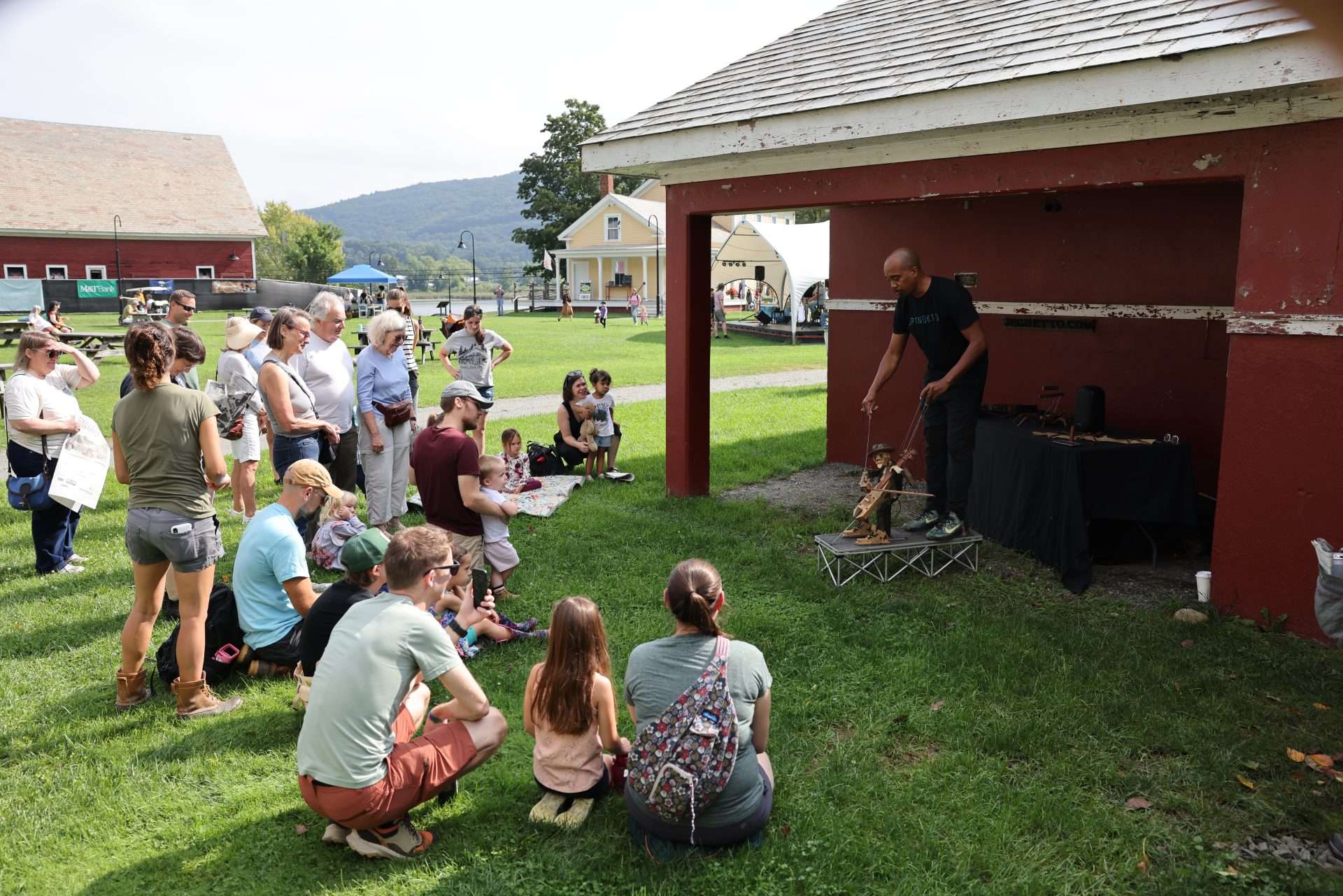 “Puppets in Paradise” in Brattleboro. Photo: Rob Strong.
The theater space itself was small—the rows were narrow and rose sharply so that even the back row couldn’t have been more than 30 feet from the stage. If that sounds intimidating, that was dismantled by the little nods of welcome throughout the room. Except for the wheelchair-accessible bottom row, the seats were all comfortable wooden benches, everyone sitting together. And a neat stack of cushions near the entrance invited everyone to make themselves feel at home.
The performance itself had a similar feeling of welcome and inclusion. The actors’ engagement with the audience didn’t have the uncomfortable quality I’m used to from other live theater, even though this was a very interactive show.
At one point, performer Sabrina Selma Mandell, as a mystic moth-dressed woman with a six-eyed scruffy companion, purports to disappear the worldly concerns of the audience into a cauldron.
“Troubles?” The moth lady inquires. The house lights come on; she gasps at all the emotional baggage the audience has brought to the room. “Give them to me!” She insists. “Give all your Troubles to me!”
And we do. We pluck our Troubles from our chests as if they were kicking and screaming on their way out and fling them at the stage. The moth and her companion become laden with their weight, stuff them into the cauldron, and disperse them into strings of white streamers.
I think about my questions melting and mixing into a stew and evaporating in this environment of mystery and hope. They are not gone, but for a moment, they are suspended in the air, transformed by the magic of puppet theater.
Tickets are on sale now for Puppets in the Green Mountains with Sandglass Theater, taking place Sept. 16-20, 2026, throughout the Brattleboro area. This long-running puppetry festival brings both local and international artists to Southern Vermont, offering awe-inspiring performances, space for connection and conversation, and a chance to celebrate the thriving art of puppet theater. Check out the schedule and get your tickets today.